Girls, my hair used to be one of the things I was most proud of.
It was long, thick, and grew like a weed. Every summer, I had to have it thinned out because there was just so much of it. Back then, I never imagined I would be looking in the mirror, trying to hide bald spots or wondering how to cover the thinning hair on top.
But here we are. My hair has changed, and so has the way I care for it.
There have been tears, frustration, toppers, full wigs, unexpected curls, and more than a few colorful hair adventures. I’m still figuring it out, but I want to share what this experience has been like for me. If you’re struggling with your changing hair, you deserve to know you aren’t alone.
This article contains affiliate links. As an Amazon Associate, I earn from qualifying purchases.
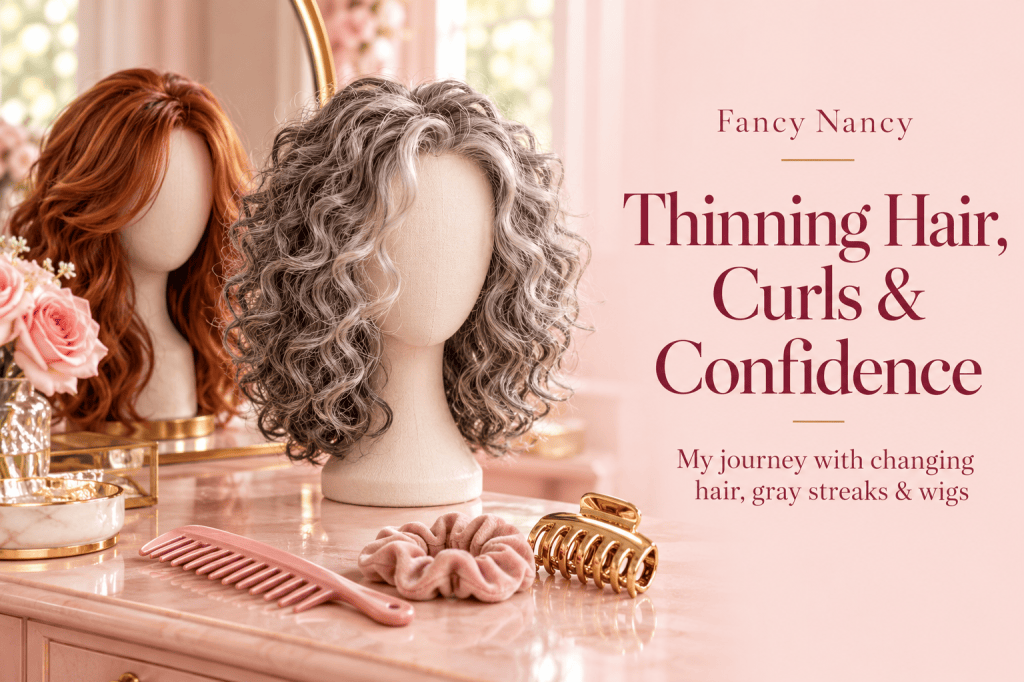
When My Hair Started Changing
I went through menopause early, at 40. My hair started thinning years later, before the pandemic. During the pandemic, I had COVID five times over an 18-month period, and my hair thinning became much worse during that time. I developed bald spots, and what had once been such an easy source of confidence became something I worried about before leaving the house.
I can describe the timing, but I can’t tell you exactly what caused every change.
Hair loss can have several causes. Female pattern hair loss becomes more common after menopause, and illness, including COVID-19, can trigger temporary shedding. That doesn’t mean every bald spot or thinning patch has the same explanation. A dermatologist can help determine what’s happening rather than leaving you to guess.[1–3]
For me, the emotional part was hard enough without trying to solve the whole mystery every time I looked in the mirror.
The Changes That Seemed to Help Me
Over time, I simplified what I was doing to my hair.
I worked on getting my vitamin D level back up. I stopped the highlights I had been using to blend in the gray. I cut back on heat styling and used only the products I needed.
These were changes I made during my own recovery. I can’t separate out exactly how much each one helped, and vitamin D isn’t a universal hair-growth remedy. If you’re concerned about a deficiency, ask your healthcare provider whether testing and supplementation make sense for you.[3,4]
Over the last year and a half, my hair has become stronger. The bald spots have filled in, and it’s growing like a weed again.
That makes me happy—but it’s still much thinner than I’m used to, especially on top. Growth and thickness aren’t the same thing, and I’m learning to appreciate the progress while being honest about what still frustrates me.
Gentler care has become my priority. Dermatologists also recommend limiting heat and handling fragile hair carefully to reduce damage and breakage.[4]
Apparently, I Have Curly Hair Now
As if the thinning wasn’t enough of an adjustment, my texture changed too.
I used to have wavy hair. Now I have very curly hair, and the new growth is coming in curly as well. Suddenly, the styling habits I had used for years didn’t seem to fit the hair on my head.
I’ve started using some curly-hair products and learning how to work with the curls. During a hot Georgia summer—or on vacation—I often just let them do their thing.
Of course, Georgia humidity likes to get involved. Some days, those curls turn into frizz, and I reach for a little gel and a scrunchie bun.
I love hairpieces and big clips that help disguise the thinner areas. The goal is an easy style that makes me feel good. One thing worth remembering: keep buns, clips, and attachments comfortable and loose. Repeated pulling can contribute to hair loss, especially when the hair is already fragile.[5]
And yes, it still frustrates me like nothing else sometimes. You can be grateful your hair is growing and still miss the hair you used to have.
The Color Shampoo I Liked—and Why I’m Taking a Break
For a while, I used Herbby Hair Color Shampoo to cover my gray.
For me, it felt less harsh than what I had been doing before, and I liked the coverage. The color faded over time in my experience. It helped me enjoy my hair again while I was adjusting to the thinning and the curls.
See the Herbby Hair Color Shampoo I used on Amazon
Lately, though, more of my gray looks white, and I’m not loving the result after coloring. The top has been looking a little more orange than the rest.
Whatever the reason, the color isn’t giving me the look I want right now.
So I’m going to stop using it for a while and see what my natural gray and white streaks look like as they grow out.
Ask me again in three months. I reserve the right to change my mind!
If you aren’t ready to grow out your gray, this is a product I personally liked using. Just remember that an “herbal” description doesn’t mean a coloring product is free of dye ingredients or unable to cause a reaction. Follow the package directions and allergy-test instructions, and do a strand test to check the color before applying it all over.[6]
Wigs Helped Me Feel Like Myself Again
I started with toppers and eventually moved to full wigs.
When my hair loss was at its worst, there were times I didn’t even feel like going out. Wigs gave me the confidence I needed to get dressed, leave the house, and enjoy myself.
Then something else happened: I started having fun.
I could be blonde, a redhead, or completely gray. I could choose hair to go with my outfit. I wore a white wig to a white party, a green one for St. Patrick’s Day, and a pink one just because I wanted to.
What started as a way to cover hair loss became another way to play with my style.
I know some people worry that changing their hair that much will make it obvious they’re wearing a wig.
Honestly? I no longer care.
People have fake teeth, fake nails, and fake boobs. We can normalize wigs, too.
I’m doing what works for me. I don’t need to feel embarrassed about something that helps me feel confident.
Giving My Own Hair a Break
I also think wearing wigs helped me give my natural hair a much-needed break from styling.
I didn’t have to use heat or keep adding styling products to make it look a certain way. My hair could stay simple underneath while I enjoyed whatever look I chose that day.
That’s my experience, not a claim that wigs make hair grow. The way a wig or topper fits matters, too. Anything that repeatedly pulls on the same areas deserves attention.[5]
I still wear toppers sometimes, but I’m careful with the clips. I want coverage without putting extra strain on the hair I’m trying to care for.
Letting the Gray Grow—and Keeping My Options
Right now, my plan is to let the gray and white grow out, keep learning about my curls, and see what happens.
Some days, I’ll wear my own hair. Some days, I’ll use a hairpiece or a big clip. Some days, I’ll put on a wig and be a redhead because that’s what I feel like doing.
I don’t have to choose one look forever.
If your hair is thinning, especially if you have bald patches, sudden shedding, or scalp discomfort, please get it checked. You deserve help understanding the cause, along with whatever styling choices help you feel comfortable in the meantime.[3]
I still miss my old thick hair. I still have frustrating days. But I’m finding ways to enjoy the hair I have—and the hair I can put on when I want something different.
A little gray, a lot of curls, or a fabulous pink wig: there’s still plenty of room for fancy.
Have you noticed your hair changing as you’ve gotten older? Are you growing out your gray, learning to love your curls, or having fun with wigs? I’d love to hear what’s working for you.
Sources and Further Reading
- American Academy of Dermatology: Could it be female pattern hair loss?
- American Academy of Dermatology: Can COVID-19 cause hair loss?
- American Academy of Dermatology: Hair loss diagnosis and treatment
- American Academy of Dermatology: Tips for managing hair loss
- American Academy of Dermatology: Hairstyles that pull can lead to hair loss
- U.S. Food and Drug Administration: Hair dyes


Leave a Reply